


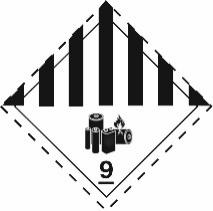
LITHIUM METAL BATTERIES (including lithium alloy batteries)
ADR 2025 · Class 9 · carriage of dangerous goods by road
- Class
- 9
- Classif.
- M4
- Hazard labels
- 9A
- Transport cat.
- 2 (E)
- Class
- 9
- Classification code
- M4
- Hazard labels
- 9A
- Limited quantities
- 0
- Excepted quantities
- E0
- Exemption limit
- 333 kg/L
Special provisions
SP 188
Cells and batteries offered for carriage are not subject to other provisions of ADR if they meet the following: (a) For a lithium metal or lithium alloy cell, the lithium content is not more than 1 g, and for a lithium ion or sodium ion cell, the watthour rating is not more than 20 Wh; NOTE: When lithium batteries in conformity with 2.2.9.1.7.1 (f) are carried in accordance with this special provision, the total lithium content of all lithium metal cells contained in the battery shall not exceed 1.5 g and the total capacity of all lithium ion cells contained in the battery shall not exceed 10 Wh (see special provision 387). (b) For a lithium metal or lithium alloy battery the aggregate lithium content is not more than 2 g, and for a lithium ion or sodium ion battery, the watthour rating is not more than 100 Wh. Lithium ion and sodium ion batteries subject to this provision shall be marked with the watthour rating on the outside case, except lithium ion batteries manufactured before 1 January 2009; NOTE: When lithium batteries in conformity with 2.2.9.1.7.1 (f) are carried in accordance with this special provision, the total lithium content of all lithium metal cells contained in the battery shall not exceed 1.5 g and the total capacity of all lithium ion cells contained in the battery shall not exceed 10 Wh (see special provision 387). (c) Each lithium cell or battery meets the provisions of 2.2.9.1.7.1 (a), (e), (f) if applicable and (g) or for sodium ion cells or batteries, the provisions of 2.2.9.1.7.2 (a), (e) and (f) shall apply; (d) Cells and batteries, except when installed in equipment, shall be packed in inner packagings that completely enclose the cell or battery. Cells and batteries shall be protected so as to prevent short circuits. This includes protection against contact with electrically conductive material within the same packaging that could lead to a short circuit. The inner packagings shall be packed in strong outer packagings which conform to the provisions of 4.1.1.1, 4.1.1.2 and 4.1.1.5; (e) Cells and batteries when installed in equipment shall be protected from damage and short circuit, and the equipment shall be equipped with an effective means of preventing accidental activation. This requirement does not apply to devices which are intentionally active in carriage (radio frequency identification (RFID) transmitters, watches, sensors, etc.) and which are not capable of generating a dangerous evolution of heat. When batteries are installed in equipment, the equipment shall be packed in strong outer packagings constructed of suitable material of adequate strength and design in relation to the packaging’s capacity and its intended use unless the battery is afforded equivalent protection by the equipment in which it is contained; (f) Each package shall be marked with the appropriate battery mark, as illustrated in 5.2.1.9; This requirement does not apply to: (i) Packages containing only button cell batteries installed in equipment (including circuit boards); and (ii) Packages containing no more than four cells or two batteries installed in equipment, where there are not more than two packages in the consignment; When packages are placed in an overpack, the battery mark shall either be clearly visible or be reproduced on the outside of the overpack and the overpack shall be marked with the word "OVERPACK". The lettering of the "OVERPACK" mark shall be at least 12 mm high. NOTE: Packages containing lithium batteries packed in conformity with the provisions of Part 4, Chapter 11, packing instructions 965 or 968, Section IB of the ICAO Technical Instructions that bear the mark as shown in 5.2.1.9 (battery mark) and the label shown in 5.2.2.2.2, model No. 9A shall be deemed to meet the provisions of this special provision. (g) Except when cells or batteries are installed in equipment, each package shall be capable of withstanding a 1.2 m drop test in any orientation without damage to cells or batteries contained therein, without shifting of the contents so as to allow battery to battery (or cell to cell) contact and without release of contents; and (h) Except when cells or batteries are installed in or packed with equipment, packages shall not exceed 30 kg gross mass. As used above and elsewhere in ADR, "lithium content" means the mass of lithium in the anode of a lithium metal or lithium alloy cell. As used in this special provision "equipment" means apparatus for which the cells or batteries will provide electrical power for its operation. Separate entries exist for lithium metal batteries and lithium ion batteries to facilitate the carriage of these batteries for specific modes of carriage and to enable the application of different emergency response actions. A single cell battery as defined in Part III, subsection 38.3.2.3 of the Manual of Tests and Criteria is considered a "cell" and shall be carried according to the requirements for "cells" for the purpose of this special provision.
SP 230
Lithium cells and batteries may be carried under this entry if they meet the provisions of 2.2.9.1.7.1. Sodium ion cells and batteries may be carried under this entry if they meet the provisions of 2.2.9.1.7.2.
SP 310
Cells or batteries from production runs of not more than 100 cells or batteries, or preproduction prototypes of cells or batteries when these prototypes are carried for testing, shall meet the provisions of 2.2.9.1.7.1 with the exception of (a), (e) (vii), (f) (iii) if applicable, (f) (iv) if applicable and (g). NOTE: "Carried for testing" includes, but is not limited to, testing described in the "Manual of Tests and Criteria", Part III, subsection 38.3, integration testing and product performance testing. These cells and batteries shall be packaged in accordance with packing instruction P910 of 4.1.4.1 or LP905 of 4.1.4.3, as applicable. Articles (UN Nos. 3537, 3538, 3540, 3541, 3546, 3547 or 3548) may contain such cells or batteries provided that the applicable parts of packing instruction P006 of 4.1.4.1 or LP03 of 4.1.4.3, as applicable, are met. The transport document shall include the following statement: "Transport in accordance with special provision 310". Damaged or defective cells, batteries, or cells and batteries contained in equipment shall be carried in accordance with special provision 376. Cells, batteries or cells and batteries contained in equipment carried for disposal or recycling may be packaged in accordance with special provision 377 and packing instruction P909 of 4.1.4.1.
SP 376
Lithium metal, lithium ion or sodium ion cells or batteries identified as being damaged or defective such that they do not conform to the type tested according to the applicable provisions of the Manual of Tests and Criteria shall comply with the requirements of this special provision. For the purposes of this special provision, these may include, but are not limited to: -Cells or batteries identified as being defective for safety reasons; -Cells or batteries that have leaked or vented; -Cells or batteries that cannot be diagnosed prior to carriage; or -Cells or batteries that have sustained physical or mechanical damage. NOTE: In assessing a cell or battery as damaged or defective, an assessment or evaluation shall be performed based on safety criteria from the cell, battery or product manufacturer or by a technical expert with knowledge of the cell’s or battery’s safety features. An assessment or evaluation may include, but is not limited to, the following criteria: (a) Acute hazard, such as gas, fire, or electrolyte leaking; (b) The use or misuse of the cell or battery; (c) Signs of physical damage, such as deformation to cell or battery casing, or colours on the casing; (d) External and internal short circuit protection, such as voltage or isolation measures; (e) The condition of the cell or battery safety features; or (f) Damage to any internal safety components, such as the battery management system. Cells and batteries shall be carried according to the provisions applicable to UN Nos. 3090, 3091, 3480, 3481, 3551 and 3552, as appropriate, except special provision 230 and as otherwise stated in this special provision. Cells and batteries shall be packed in accordance with packing instructions P908 of 4.1.4.1 or LP904 of 4.1.4.3, as applicable. Cells and batteries identified as damaged or defective and liable to rapidly disassemble, dangerously react, produce a flame or a dangerous evolution of heat or a dangerous emission of toxic, corrosive or flammable gases or vapours under normal conditions of carriage shall be packed and carried in accordance with packing instruction P911 of 4.1.4.1 or LP906 of 4.1.4.3, as applicable. Alternative packing and/or carriage conditions may be authorized by the competent authority of any ADR Contracting Party who may also recognize an approval granted by the competent authority of a country which is not an ADR Contracting Party provided that this approval has been granted in accordance with the procedures applicable according to RID, ADR, ADN, the IMDG Code or the ICAO Technical Instructions. Packages shall be marked "DAMAGED/DEFECTIVE LITHIUM ION BATTERIES", "DAMAGED/DEFECTIVE LITHIUM METAL BATTERIES" or "DAMAGED/DEFECTIVE SODIUM ION BATTERIES", as applicable. The transport document shall include the following statement “Transport in accordance with special provision 376”. If applicable, a copy of the competent authority approval shall accompany the carriage.
SP 377
Lithium metal, lithium ion and sodium ion cells and batteries and equipment containing such cells and batteries carried for disposal or recycling, either packed together with or packed without nonlithium or nonsodium ion batteries, may be packaged in accordance with packing instruction P909 of 4.1.4.1. These cells and batteries are not subject to the provisions of 2.2.9.1.7.1 (a) to (g) or 2.2.9.1.7.2 (a) to (f), as appropriate. Packages shall be marked "LITHIUM BATTERIES FOR DISPOSAL", "SODIUM ION BATTERIES FOR DISPOSAL", "LITHIUM BATTERIES FOR RECYCLING" or "SODIUM ION BATTERIES FOR RECYCLING", as appropriate. Identified damaged or defective batteries shall be carried in accordance with special provision 376.
SP 387
Lithium batteries in conformity with 2.2.9.1.7.1 (f) containing both primary lithium metal cells and rechargeable lithium ion cells shall be assigned to UN Nos. 3090 or 3091 as appropriate. When such batteries are carried in accordance with special provision 188, the total lithium content of all lithium metal cells contained in the battery shall not exceed 1.5 g and the total capacity of all lithium ion cells contained in the battery shall not exceed 10 Wh.
SP 636
Up to the intermediate processing facility, lithium cells and batteries or sodium ion cells and batteries with a gross mass of not more than 500 g each, lithium ion or sodium ion cells with a watthour rating of not more than 20 Wh, lithium ion or sodium ion batteries with a watthour rating of not more than 100 Wh, lithium metal cells with a lithium content of not more than 1 g and lithium metal batteries with an aggregate lithium content of not more than 2 g, not contained in equipment, collected and handed over for carriage for sorting, disposal or recycling, together with or without other cells or batteries, are not subject to the other provisions of ADR including special provision 376 and 2.2.9.1.7.1 and 2.2.9.1.7.2, if the following conditions are met: (a) The cells and batteries are packed according to packing instruction P909 of 4.1.4.1 except for the additional requirements 1 and 2; (b) A quality assurance system is in place to ensure that the total amount of lithium cells and batteries and sodium ion cells and batteries per transport unit does not exceed 333 kg; NOTE: The total quantity of lithium cells and batteries and sodium ion cells and batteries in the mix may be assessed by means of a statistical method included in the quality assurance system. A copy of the quality assurance records shall be made available to the competent authority upon request. (c) Packages are marked "LITHIUM BATTERIES FOR DISPOSAL", "LITHIUM BATTERIES FOR RECYCLING", "SODIUM ION BATTERIES FOR DISPOSAL" or "SODIUM ION BATTERIES FOR RECYCLING", as appropriate.
SP 677
Cells and batteries which, in accordance with special provision 376, are identified as damaged or defective and liable to rapidly disassemble, dangerously react, produce a flame or a dangerous evolution of heat or a dangerous emission of toxic, corrosive or flammable gases or vapours under normal conditions of carriage, shall be assigned to transport category 0. In the transport document, the words "Carriage in accordance with special provision 376" shall be supplemented by the words "Transport category 0".