


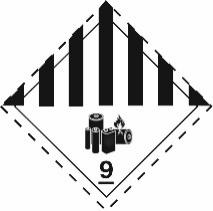
VEHICLE, LITHIUM ION BATTERY POWERED
ADR 2025 · Class 9 · carriage of dangerous goods by road
- Class
- 9
- Classif.
- M11
- Hazard labels
- 9A
- Transport cat.
- - (-)
- Class
- 9
- Classification code
- M11
- Hazard labels
- 9A
- Limited quantities
- 0
- Excepted quantities
- E0
- Packing instructions
- P912
- Transport category
- - (-)
Special provisions
SP 388
UN No. 3166 entries apply to vehicles powered by flammable liquid or gas internal combustion engines or fuel cells. Vehicles powered by a fuel cell engine shall be assigned to the entries UN 3166 VEHICLE, FUEL CELL, FLAMMABLE GAS POWERED or UN 3166 VEHICLE, FUEL CELL, FLAMMABLE LIQUID POWERED, as appropriate. These entries include hybrid electric vehicles powered by both a fuel cell and an internal combustion engine with wet batteries, sodium batteries, lithium metal batteries or lithium ion batteries, carried with the battery(ies) installed. Other vehicles which contain an internal combustion engine shall be assigned to the entries UN 3166 VEHICLE, FLAMMABLE GAS POWERED or UN 3166 VEHICLE, FLAMMABLE LIQUID POWERED, as appropriate. These entries include hybrid electric vehicles powered by both an internal combustion engine and wet batteries, sodium batteries, lithium metal batteries or lithium ion batteries, carried with the battery(ies) installed. If a vehicle is powered by a flammable liquid and a flammable gas internal combustion engine, it shall be assigned to UN No. 3166 VEHICLE, FLAMMABLE GAS POWERED. Entry UN 3171 only applies to vehicles and equipment powered by wet batteries, metallic sodium batteries or sodium alloy batteries, carried with these batteries installed. UN No. 3556 VEHICLE, LITHIUM ION BATTERY POWERED, UN 3557 VEHICLE, LITHIUM METAL BATTERY POWERED and UN No. 3558 VEHICLE, SODIUM ION BATTERY POWERED, as applicable, apply to vehicles powered by lithium ion, lithium metal or sodium ion batteries carried with the batteries installed. For the purpose of this special provision, vehicles are selfpropelled apparatus designed to carry one or more persons or goods. Examples of such vehicles are cars, motorcycles, scooters, threeand fourwheeled vehicles or motorcycles, trucks, locomotives, bicycles (pedal cycles with a motor) and other vehicles of this type (e.g. selfbalancing vehicles or vehicles not equipped with at least one seating position), wheelchairs, lawn tractors, selfpropelled farming and construction equipment, boats and aircraft. When vehicles are carried in a packaging, some parts of the vehicle, other than the battery, may be detached from its frame to fit into the packaging. Examples of equipment are lawnmowers, cleaning machines or model boats and model aircraft. Equipment powered by lithium metal batteries or lithium ion batteries shall be assigned to the entries UN 3091 LITHIUM METAL BATTERIES CONTAINED IN EQUIPMENT or UN 3091 LITHIUM METAL BATTERIES PACKED WITH EQUIPMENT or UN 3481 LITHIUM ION BATTERIES CONTAINED IN EQUIPMENT or UN 3481 LITHIUM ION BATTERIES PACKED WITH EQUIPMENT, as appropriate. Lithium ion batteries or lithium metal batteries installed in a cargo transport unit and designed only to provide power external to the cargo transport unit shall be assigned to the entry UN 3536 LITHIUM BATTERIES INSTALLED IN CARGO TRANSPORT UNIT lithium ion batteries or lithium metal batteries. Dangerous goods, such as batteries, airbags, fire extinguishers, compressed gas accumulators, safety devices and other integral components of the vehicle that are necessary for the operation of the vehicle or for the safety of its operator or passengers, shall be securely installed in the vehicle and are not otherwise subject to ADR. However, lithium batteries shall meet the provisions of 2.2.9.1.7.1, except that (a), (e) (vii), (f) (iii) if applicable, (f) (iv) if applicable and (g) do not apply when batteries of a production run of not more than 100 cells or batteries, or preproduction prototypes of cells or batteries when these prototypes are carried for testing, are installed in vehicles. Furthermore, sodium ion batteries shall meet the provisions of 2.2.9.1.7.2, except that (a), (e) and (f) do not apply when batteries of a production run of not more than 100 cells or batteries, or preproduction prototypes of cells or batteries when these prototypes are carried for testing, are installed in vehicles. Where a lithium battery installed in a vehicle is damaged or defective, the vehicle shall be carried in accordance with the conditions defined in special provision 667 (c).
SP 666
Vehicles and battery powered equipment, referred to by special provision 388, when carried as a load, as well as any dangerous goods they contain that are necessary for their operation or the operation of their equipment, are not subject to any other provisions of ADR, provided the following conditions are met: (a) For liquid fuels, any valves between the engine or equipment and the fuel tank shall be closed during carriage unless it is essential for the equipment to remain operational. Where appropriate, the vehicles shall be loaded upright and secured against falling; (b) For gaseous fuels, the valve between the gas tank and engine shall be closed and the electric contact open unless it is essential for the equipment to remain operational; (c) Metal hydride storage systems shall be approved by the competent authority of the country of manufacture. If the country of manufacture is not a contracting party to ADR the approval shall be recognized by the competent authority of a contracting party to ADR; (d) The provisions of (a) and (b) do not apply to vehicles which are empty of liquid or gaseous fuels; NOTE 1: A vehicle is considered to be empty of liquid fuel when the liquid fuel tank has been drained and the vehicle cannot be operated due to a lack of fuel. Vehicle components such as fuel lines, fuel filters and injectors do not need to be cleaned, drained or purged to be considered empty of liquid fuels. In addition, the liquid fuel tank does not need to be cleaned or purged. NOTE 2: A vehicle is considered to be empty of gaseous fuels when the gaseous fuel tanks are empty of liquid (for liquefied gases), the pressure in the tanks does not exceed 2 bar and the fuel shutoff or isolation valve is closed and secured. (e) Vehicles that are fully enclosed by packagings, crates or other means that prevent ready identification are subject to the marking and labelling requirements of Chapter 5.2. Alternatively, for sodium ion battery powered vehicles, see special provision 404.
SP 667
(a) (Deleted) (b) The provisions of 2.2.9.1.7.1 and 2.2.9.1.7.2 do not apply to lithium cells or batteries or sodium ion cells or batteries in damaged or defective vehicles, engine or machinery. In such cases the following conditions shall be met: (i) If the damage or defect has no significant impact on the safety of the cell or battery, damaged and defective vehicles, engines or machinery, may be carried under the conditions defined in special provisions 363 or 666, as appropriate; (ii) If the damage or defect has a significant impact on the safety of the cell or battery, the lithium cell or battery or the sodium ion cell or battery shall be removed and carried according to special provision 376; However, if it is not possible to safely remove the cell or battery or it is not possible to verify the status of the cell or battery, the vehicle, engine or machinery may be towed or carried as specified in (i). (c) The procedures described in (b) also apply to damaged lithium cells or batteries or sodium ion cells or batteries in vehicles, engines or machinery.
SP 669
A trailer fitted with equipment, powered by a liquid or gaseous fuel or an electric energy storage and production system, that is intended for use during carriage operated by this trailer as a part of a transport unit, shall be assigned to UN No. 3166, 3171, 3556, 3557 or 3558, as appropriate and be subject to the same conditions as specified for these UN numbers, when carried as a load on a vehicle, provided that the total capacity of the tanks containing liquid fuel does not exceed 500 litres.